
Assisi
A town of twenty-eight thousand people that receives four million.
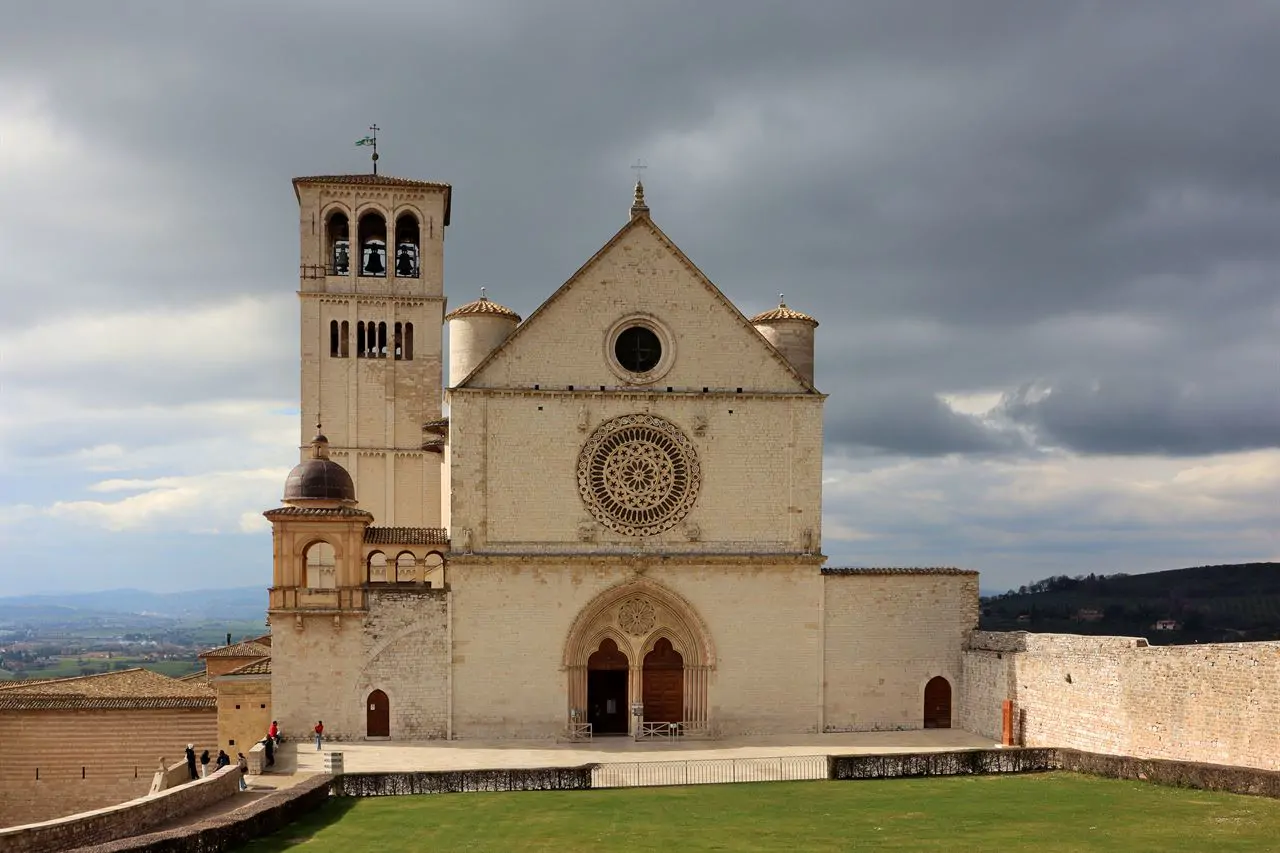
Assisi is set against the flank of Monte Subasio and can be seen from the whole Valle Umbra, white because it is built of the pink stone of the mountain. It began as a Roman town, and the temple of Minerva still stands in the square, but what it is known for happened between 1181 and 1226, that is the life of Francis.
The basilica of St Francis was begun in 1228, two years after his death, and it is two churches one above the other. The upper one holds the cycle of the Stories of St Francis, attributed to Giotto and his workshop; in the lower one Cimabue, Simone Martini and Pietro Lorenzetti worked. Since 2000 the basilica and the other Franciscan sites have been Unesco heritage.
The rest of the town
Above the basilica the town climbs to the Rocca Maggiore, and the way passes through Piazza del Comune, where the Roman temple stands with its six columns. Santa Chiara, with its white and pink banded front and its buttressing arches, holds the crucifix of San Damiano. Outside, on the plain, is Santa Maria degli Angeli, an enormous basilica built around the Porziuncola, the chapel where Francis lived.
How to visit it
Entry to the basilica is free and needs no booking, but early morning is the right choice: after ten the groups arrive. Cars are left in the car parks outside the walls, linked by escalators and shuttles, because the centre is closed. Covered clothing is needed to enter the churches, and that holds in summer too.
Above the town is the Monte Subasio park, with the Eremo delle Carceri four kilometres away: a narrow climbing road, a holm oak wood and the caves where Francis withdrew. Anyone camping on Trasimeno gets there in three quarters of an hour.